AI’s Transcription Reveals Startling Results

Handwritten AI in the center of the swirling circular line

At Gigantic, like so many others, we have been using Artificial Intelligence (AI) in our work, to see how/if it saves time or increases creativity or quality of work, with mixed results (see past blogs here and here). A recent experience we had with AI raised some serious questions. We are sharing this to help others choose how to work with this tool to get the most useful results.

Can AI Save Time and Heartache?

The Gigantic team conducted a workshop at a recent statewide conference on illegal dumping. As part of the exercise, attendees were asked to come up with headlines that could describe the steps to a future free of illegal dumping in California. Participants filled out simple forms, writing in pen. These were collected at the end of the session. Transcribing can be a time sink, so we decided to see if AI could save some time and heartache. We asked ChatGPT to transcribe the handwritten forms, which it did, very quickly.


Startling Examples

I certainly expected to see some misspellings and misinterpreted words, and there was some of that. But what we found led to going over each sheet, word by word, comparing what we saw with what ChatGPT interpreted. Some of the “interpretations” were startling…and disturbing.

Here are just a few of the many examples we found:

Original handwritten:

Headline: Plastic Now a Thing of the Past

Subhead: Reuse and recycling are now so mainstream that the plastics industry is nearing extinction

ChatGPT transcription:

Headline: Plastic Now a Thing of the Past

Subhead: Reusable packaging are now mainstream what was once considered weird is now the norm

The above is not a misreading of individual words. It feels like a purposeful hiding of the original intent of holding the plastics industry responsible for its products’ pollution.

Another example did not recognize the widely discussed “billionaire tax”:
Original:

Headline: Billionaires tax funds Illegal Dumping department in largest cities. 

Subhead: Trash identification software for safe sorting, robotic trash retrieval systems and state of the art cameras are now in use. 

ChatGPT:

Headline: Billions in funds allocated to illegal dump reduction in most cities

Subhead: State funded cameras and prosecution of repeat offenders

“Prosecution of repeat offenders”  seems to be a strange substitution for the technological solutions originally listed.

My favorite mistake shows that ChatGPT is not sensitive to satire:

Original:

Headline: Surveillance state achieved!

Subhead: AI cameras on every corner monitoring activities

ChatGPT:

Headline: Governor signs Acton? (sic)

Subhead: AI cameras reduce waste management costs

 
 How AI “Transcribes”

As you know, AI works by scraping the Internet, then “guessing”, based on previous patterns and content, the answers to questions that are put to it.

I had some suspicions about why these particular words/ideas were being changed. I asked ChatGPT, and got the answer:

This is called “hallucination”

In AI, a hallucination occurs when the model generates information that is plausible but not actually present in the input.

With handwritten documents, hallucinations become more common because:

    • handwriting is ambiguous;
    • scans or photos may be low quality;
    • some words are partially obscured;
    • the model is optimized to produce coherent language.

Rather than outputting:

“[illegible]”

it often substitutes something that “fits the topic.” (my quotes)

Sure, OK. We have heard of hallucinations — AI does not always tell the truth.

Another concern is that the information sources “scraped” by AI are dominated by particular interests and points of view. This algorithmic bias has been extensively documented. Also concerning is that it is estimated that as much as 50% of current web content is already AI generated, which then could be re-absorbed by AI scraping. Surely this will lead to amplified bias, a dumber Internet…and dumber humans?

And for those of us in the environmental space, the toll of AI on resources presents thorny ethical challenges. Should we use this tool – that is radiating climate-damaging heat, using up water and making untenable energy demands – to help people make better recycling choices?


What Have We Learned?

In the end, the necessary cross-checking of some 70 handwritten sheets took about the same amount of time as entering it from scratch. While time was not saved, we gained some valuable insights into how to use  – and not use – AI.

If you want to repeat the transcription exercise (or something similar), one lesson is to be alert to bias and to be very specific in your instructions. Tell the AI (below is suggested by AI):

“Transcribe the handwriting exactly as written. Do not rewrite, summarize, interpret, or improve the text. If any word is uncertain, reproduce your best reading and mark it with [?]. If a word cannot be read, write [illegible]. Preserve spelling, grammar, punctuation, and line breaks exactly.”

However, more broadly, I think these examples show how dangerous and disingenuous relying on AI can be. AI is only as smart as the content it has absorbed. The content it has absorbed is the Internet. Think about some of the slop you’ve seen and ask yourself, “Is this what I can trust?”

Good luck out there!

 

When in Doubt: The Power of Subtraction

“When in doubt, take it out” is a rule I apply as often as possible when editing my own writing and that of others. By removing words or seeking simpler vocabulary or constructions, writing often becomes more clear, comprehensible and even beautiful.

Subtract book cover
The suitably simple cover design for Klotz’s Subtract.

A new book by Leidy Klotz, professor at the University of Virginia, takes the idea of ‘taking away’ to a whole new level.  Subtract: The Untapped Science of Less posits that humans are programmed to solve problems by adding stuff – elements, ideas or things – whereas subtracting them often clarifies and eases a problem. One of the book’s first examples is the removal of the Embarcadero Freeway in San Francisco. The project was opposed by a majority of citizens and politicians on a number of operational and economic grounds. Yet once the freeway, damaged in the Loma Prieta quake, was removed, the benefits became obvious – and huge. Klotz notes “The decade after removal saw a 50 percent increase in housing and a 15 percent increase in jobs around the waterfront. (p. 3)  A beautiful space was created, businesses thrived, people flocked and … traffic became less snarled.

Are there environmental problems that can be addressed by removing rather than adding? Klotz addresses this possibility and gives some examples. He suggests applying subtraction to the 3Rs: “When the current situation exceeds planetary boundaries, we need to subtract first. Remove must become the first R.” (p.210)

Klotz’s research is introduced in the video below. While subtraction is not the answer to every problem, it’s another tool we can use when approaching environmental outreach…and everyday life.

Moving from Awareness to Action at the Food Waste Summit

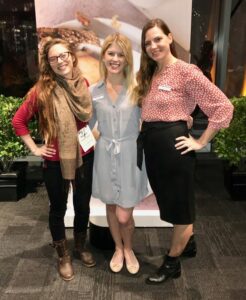
Left to right: Nicole Greenspan from Gigantic Idea Studio with clients Lisa Coelho and Amber Duran from SCS Engineers.

While we often work on projects that make composting cool, more and more of Gigantic’s clients are moving up the food recovery hierarchy and asking for outreach about reducing food waste at the source. The goal of cutting food waste in America in half by 2030 was central to the 2019 Food Waste Summit, hosted by ReFED in San Francisco.

The theme was “moving from awareness to action”, with speakers sharing strategies to cut food waste while increasing food security, spurring economic growth and combating climate change. They “set the table” with the cascading impacts of wasting food, gave a “toast to progress” with examples of success at food businesses, and shared innovative approaches to preventing food waste throughout the food system. There was even a cooking demo from one of America’s top chefs, Tiffany Derry, who encouraged attendees to partner with chefs to engage more communities with approachable stories about the value of food.

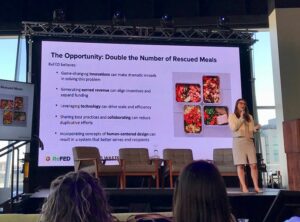
Alexandria Coari, Capital & Innovation Director at ReFED, shares the opportunities of the Nonprofit Food Recovery Accelerator.

With 40% of food wasted in this country while 40 million Americans are food insecure, there was a big emphasis on how to close the hunger gap with food recovery. ReFED highlighted their Nonprofit Food Recovery Accelerator program with the goal to double the number of rescued meals in America. Nonprofits like Replate, Seeds That Feed, Plentiful, and Brighter Bites shared how they’re exploring innovative earned revenue, technology and human-centered design solutions to scale healthy food access with dignity for the millions facing food insecurity. While these solutions provide real relief, the question came up of whether they go far enough to address the core causes of hunger or food waste in America.

The “Mobile Blast Chiller” van developed by MGM Resorts International, Peravan, and Three Square.

The Summit showcased several technology solutions for better food storage and transport, waste tracking, and end of life management, including Seal the Seasons, Goodr, Leanpath, Winnow, and Mobius. The “Mobile Blast Chiller” van, pictured at right, was developed by MGM Resorts International, Peravan, and Three Square in Las Vegas, to rapidly cool prepared food as it drives, improving food transport safety and efficiency. Apeel Sciences shared how they’re challenging the notion that we need single-use plastic packaging to solve the food waste problem with a peel-inspired produce coating that keeps produce fresher, longer.

ReFED emphasized the need for more public-private partnerships to create demand for waste reduction like the Pacific Coast Collaborative (PCC) and the Federal Winning on Reducing Food Waste Strategy. Government has a key role to play in improving donation liability protection and awareness, standardizing date labeling (e.g. “best if used by” date), and incentivizing organics from the landfill and edible food recovery with bills like SB 1383. The Summit wrapped up with a panel on turning waste into value where they emphasized the need for strong government regulations to ramp up organics recycling capacity given the current economic conditions.

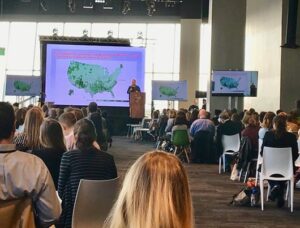
Ami McReynolds, Chief Equity and Programs Offer at Feeding America, shows a map of food insecurity in America.

When I reflect on the Summit and the amazing conversations during and afterwards, I’m left wondering who was not in the room and how that might have changed the dynamic. How we don’t have all the answers, as Ami McReynolds, Chief Equity and Programs Officer at Feeding America observed, and that we need to create a more inclusive environment to bring new voices to the conversation. “How can we build and earn trust with communities?” McReynolds asked at the end of her presentation, “What will it take to be bold and courageous collaborators with communities?” We’re grateful for our incredible clients who are working closely with communities to co-create solutions that address the real needs and root causes of these complex challenges.

Recycling Spot Checks: Flipping Lids in Livermore

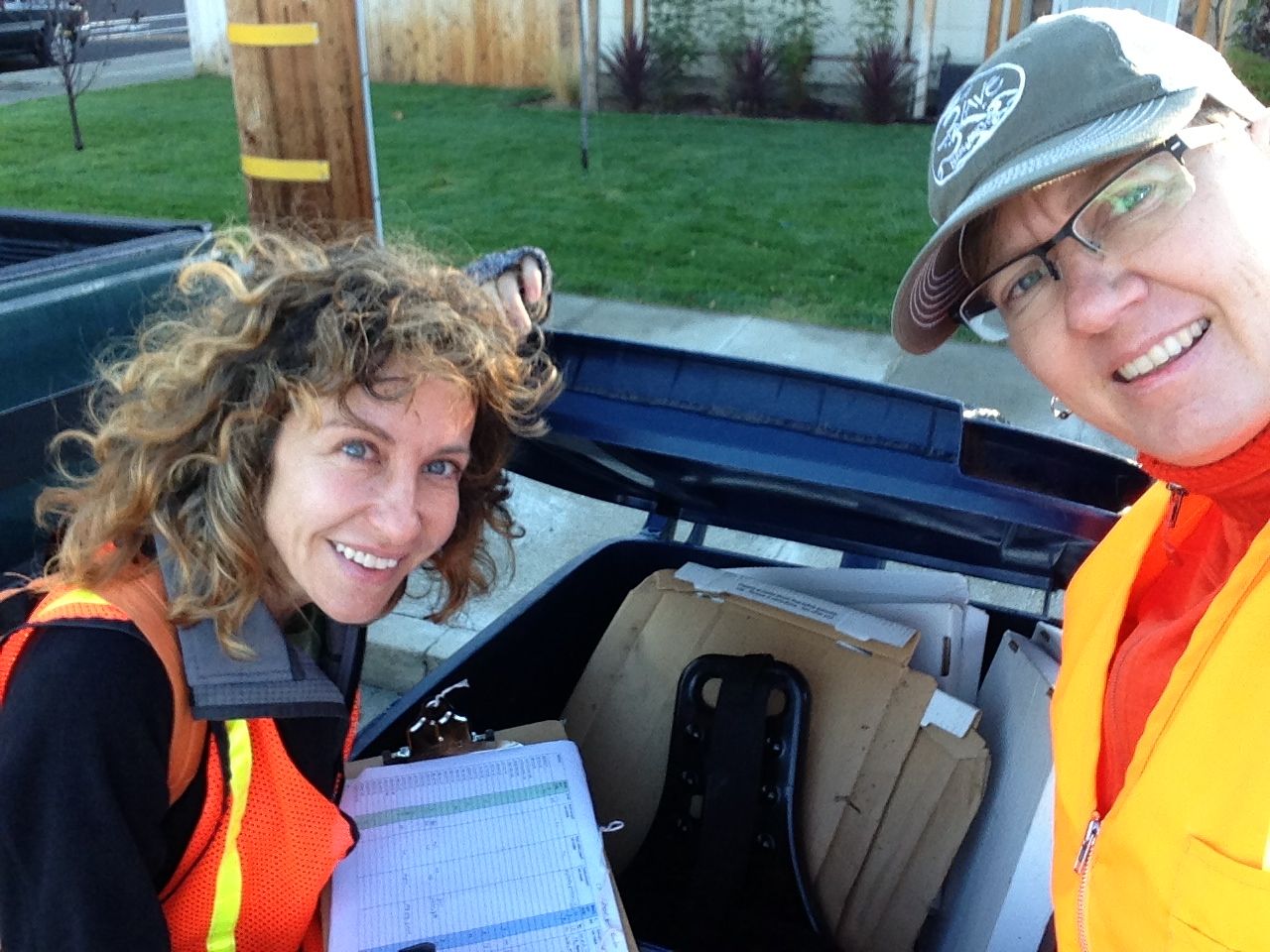
During the last week of September, my colleague Stefanie Pruegel (pictured left) and I (pictured right) donned orange safety vests and set out before sunrise to study recycling program participation in various neighborhoods in Livermore, California. Armed with headlamps, clipboards and maps, we walked some 20 miles over five days and flipped about 2,000 recycling and organics cart lids.

Stef and I flipping Livermore lids.

This walkabout was part of our observational research to gain insights into residents’ recycling and composting habits, including contamination patterns (i.e., putting things in the wrong carts). The data we gathered will also measure the baseline participation rate. Repeating this measurement after an outreach campaign will allow us to compare the results and determine how successful we were as well as guide the next phase of outreach. This particular kind of measurement can be a messy job, but someone’s gotta do it.

During our lid-flipping adventures, several patterns emerged:

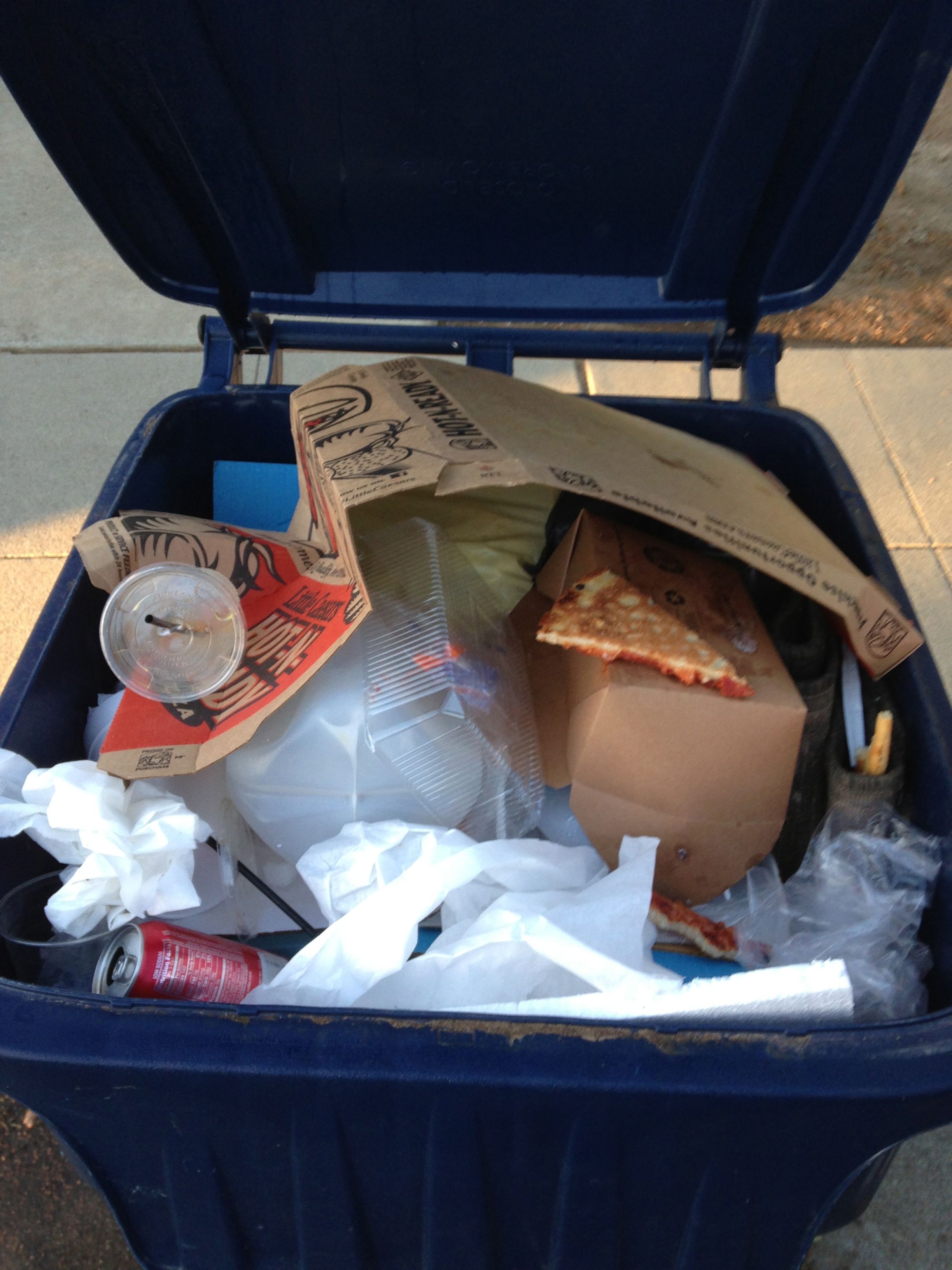
• Livermore loves pizza and is confused about leftovers.  In Livermore, the proper process is to chuck pizza boxes and leftovers into the Organics (compost) cart. Pizza boxes are considered food-soiled paper (as are most fast food paper wrappers), and pizza crusts are considered food scraps – all of which goes into Organics. However, we found households were evenly split over whether to put the box in Recycling or Organics.

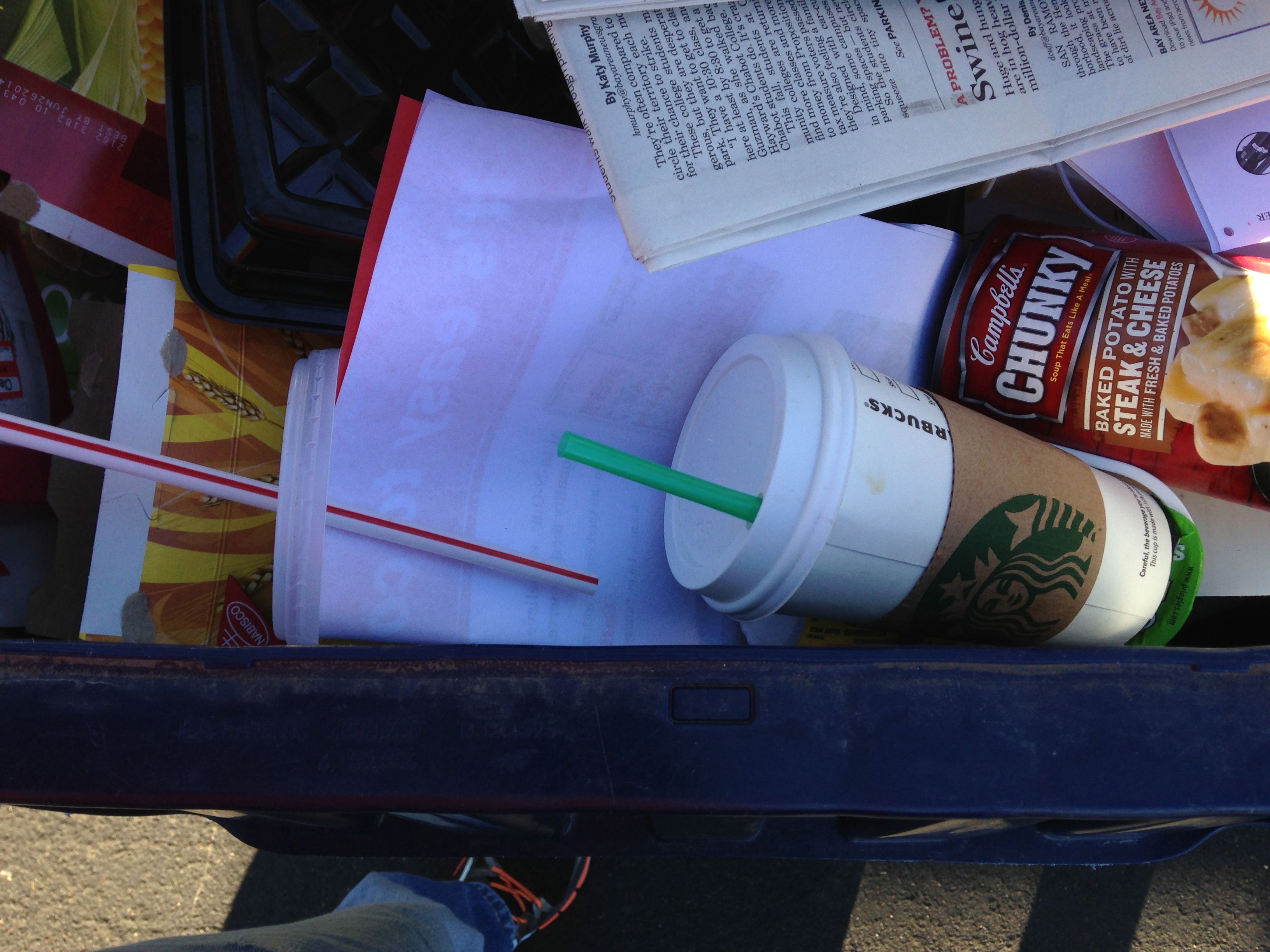
• Livermore is a thirsty bunch, and cup sorting is a challenge.  What is the preferred destination for takeout cups, lids and straws? These items are made of both plastic and paper, and each needs to be handled IMG_2610differently. This leads to a lot of consumer confusion. We found that no matter if the cups were for cold drinks (plastic) or hot drinks, (paper) the majority ended up in the recycling cart, along with their lids and straws. But, the lids and straws actually go into the garbage, and the paper cups go in the organics. This kind of contamination adds considerable expense for waste haulers and ultimately can drive up trash rates. (Please Note: This is a general observation and not a prediction for Livermore.)

• Livermore has beautiful yards, and sorting the waste is a conundrum.  Throughout the week we “ooh-ed” and “ah-ed” at the beautiful yards and landscaping in the neighborhoods we saw. However, many residents seemed to assume that anything from the yard belongs in the Organics cart. In fact, certain items like pet waste belongs in Garbage, not Organics. Putting whatever blows (or gets pooped) in people’s yards into the Organics cart causes another costly contamination headache.

We saw some clear consistencies in what was going right and wrong in the carts. Next we will tabulate our findings, design an outreach campaign to focus on the most prevalent behaviors that need to change, and afterwards, check those carts again. We look forward to helping the city and the citizens of Livermore “sort out” any issues and move forward with their waste reduction goals.


Overconcerning Yourself with the Unconcerned? Busting the Myth of “People Don’t Care”

Unconcerned womanMyth: So often we hear that getting people to change their behaviors is futile because people just “don’t care.”

This idea is unfortunate because it can cause you to become discouraged and to give up on outreach. The reality is quite different from this bleak perspective; the number of people walking around with the “don’t care” point of view is actually very small.

Don’t Let One Bad Apple Spoil the Party  

Say you have four relatives coming over for dinner: Grandma Sadie, Uncle Burt, Aunt Priscilla and Cousin Chester. Sadie adores pastry and is an avid cook; Burt and Priscilla both enjoy some form of dessert regularly; Chester hates anything sweet after meals. You could spend the whole day lamenting the fact that Chester won’t like your apple pie and eventually decide to skip dessert altogether. Or you could make the darned pie and delight as the other three gobble it down with glee!

What’s this got to do with environmental outreach, you ask?

“Unconcerneds” by the Numbers

In 2006 the Natural Marketing Institute segmented the U.S. population by degree of concern for environmental issues, and found that approximately 16% falls into the LOHAS (Lifestyles of Health and Sustainability) segment, the deep green consumers that are passionate about environment and socially responsible business.

Only 14 percent of the population fell into the Unconcerned category.

The Natural Marketing Institute defines “Unconcerneds” as “unconcerned about the environment and society” and “dealing with day-to-day challenges.” These are not the folks to be marketing much of anything to, much less the complex and long-horizon topic of environmental behavior change. If these people are the only ones who could accurately be described as “not caring,” that leaves 86% who do care! As it turns out, 41% care a lot (these are the so-called LOHAS and Naturalite segments). Now isn’t that a more inspiring view of the world?

The idea that people don’t care can become an excuse for not trying, for turning away from outreach to more punitive or technology-based solutions: for giving up on people’s better nature. The fact is, the vast majority of people do care to some degree or another, and with research, careful messaging and loads of patience, change is possible. So cheer up and pass the pie!